
Guide to the Property Mortgage Release Process in Dubai
Property mortgage release in Dubai is something most homeowners run into eventually, usually right when they’re ready to do something big with their property. Buying your home felt like the finish line until you find out the bank’s claim is still sitting on your title long after the loan is gone.
If you’ve just paid off your mortgage, you’re getting ready to sell, or you’re switching to a better deal through refinancing, there’s one step you can’t skip: a property mortgage release in Dubai, the process that removes the bank’s hold on your property at the Dubai Land Department. Until it’s done, the property stays officially mortgaged even when you’ve repaid every dirham, which means you can’t freely sell, gift, or transfer it.
In this guide, we’ll walk you through what a property mortgage release actually is, when you’ll need one, the exact steps and documents involved, what it costs, how to sell a mortgaged property, and even how to get it all handled through a Power of Attorney if you’re not in Dubai.
Key Takeaways
- A property mortgage release in Dubai removes the bank’s lien from your property record at the Dubai Land Department and gives you a clean title deed.
- Paying off your loan is not the same as releasing the mortgage. The property stays officially mortgaged in the DLD records until you complete the release.
- A standard release costs around AED 1,000 plus AED 250 for the new title deed, roughly AED 1,270 through the bank’s online system.
- At a Trustee Centre, the release itself takes about 10 to 15 minutes, though bank steps like the clearance letter can take several days.
- If you are outside Dubai, a Power of Attorney lets a trusted representative complete the release for you without travelling.
Table of Contents
What is a property mortgage release in Dubai?
When you buy property with bank financing in Dubai, the bank doesn’t just trust you to pay it back. It protects itself. It registers a claim against your property at the Dubai Land Department, and that claim is what people call a “lien” or a “mortgage annotation.”
A mortgage release is the registration procedure that removes the bank’s security interest from your record. Strip away the jargon, and it’s basically this: the bank’s name comes off your title deed, and the property becomes fully, cleanly yours on paper.
Why Would You Release a Property Mortgage in Dubai?
You’d release a mortgage because, until you do, you can’t really do anything meaningful with your property, and three life moments tend to force the issue: finishing your loan, selling, or refinancing.
You do it because until the deregistration is complete, the property stays encumbered in the DLD’s records even if the loan is fully repaid, which blocks you from selling, gifting, or transferring it.
Maybe you’ve paid off your home early and want a clean title in your name. Maybe a buyer’s ready, and you can’t transfer until your mortgage is clear.
When is a Property Mortgage Release in Dubai Required?
There are three moments when it lands on your plate, and you’ll almost certainly hit at least one of them.
When you’ve finished paying off the loan
This is the obvious one. You’ve made the last payment, or you’ve settled the whole balance in a lump sum, and you’re done with the bank. At that point, the bank issues a mortgage release letter confirming you owe nothing more, and you take that to the DLD to have the annotation removed and a clean title deed issued.
When you’re selling the property
If your property still carries a loan, you can’t just hand over the keys and pocket the money. The release happens as part of the sale itself, where the buyer’s payment (or their bank’s financing) is used to settle your outstanding mortgage, and the bank issues the release letter once those funds come in. The DLD then handles the release and the ownership transfer in one coordinated sequence.
When you’re refinancing with a new lender
When you refinance, the existing mortgage has to be released before the new one is properly registered.
So your old lender’s claim comes off, your new lender’s claim goes on, and the property never sits “free” in between. It’s less of a clean break and more of a handover. If your mortgage advisor doesn’t flag this for you, ask about it directly, because the timing has to line up or the whole refinance can stall.
What Are the Steps to Release a Mortgage on a Property in Dubai?
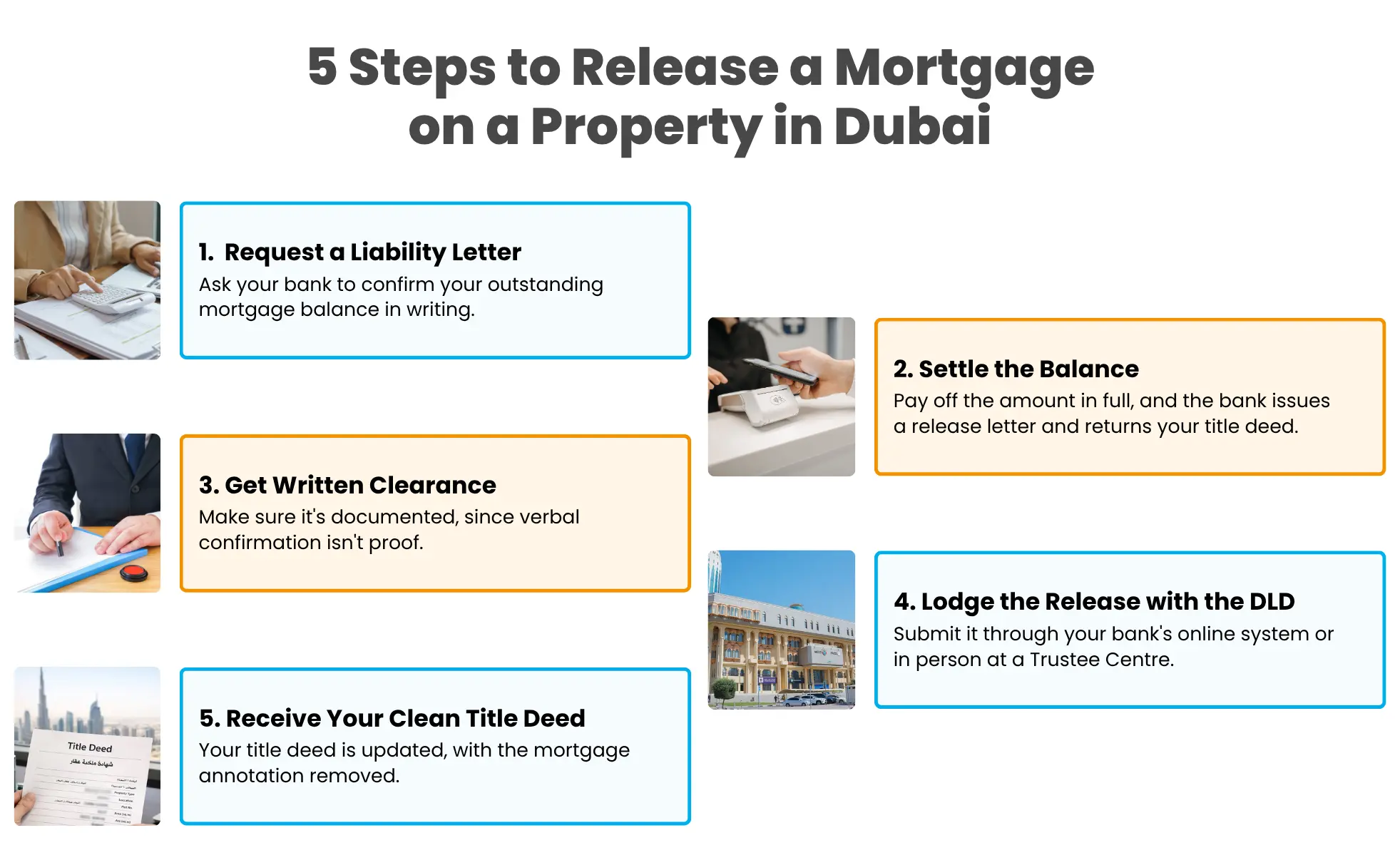
The steps are: get a liability letter, settle the balance, collect your clearance letter and title deed, lodge the release with the DLD, and receive your clean title deed.
- Request a liability letter from your bank – It states your exact outstanding balance and any settlement charges. Banks usually issue this in 5 to 7 working days, and it stays valid for 30 to 60 days.
- Settle the balance in full – Once the funds land, the bank issues your mortgage release letter and returns your original title deed.
- Collect the written clearance letter – Never accept a verbal confirmation. This document is what proves you’re clear.
- Lodge the release with the DLD, either through the bank’s online system or at a Trustee Centre.
- Receive your updated title deed, now free of any mortgage annotation.
Property isn’t the only asset a bank keeps a hold on. If you’ve also financed a car here, the process runs through the RTA instead of the DLD, and our guide to the vehicle mortgage release process in Dubai covers the steps, timeline, and documents.
Required Documents for Mortgage Release
What you need depends on how you submit. The DLD sets slightly different document requirements for the two channels, so here’s exactly what each one calls for.
If the bank processes it online
When a standard release runs electronically through your bank, the paperwork on your side is almost nothing:
- Owner’s Emirates ID, shown for identification only (no copy is submitted)
That’s effectively it for you. The bank handles everything else internally, uploading the release letter and related documents into the DLD’s online mortgage system through the digital safe. It’s the lightest-touch option, which is exactly why so many owners prefer it for a clean, standalone release.
If you process it in person at a Trustee Centre
Doing it face to face at an authorised Real Estate Registration Trustee Centre? You’ll bring two things:
- Mortgage release letter from the bank, confirming the debt is fully settled
- Owner’s Emirates ID, again for identification only (no copy is submitted)
Simple enough on its own. But the in-person route isn’t always optional, and that’s the part owners need to understand.
When the Trustee Centre route becomes mandatory
Some releases can’t go through the bank’s online system at all. If your release is tied to a follow-on procedure, the DLD requires the application to be lodged in person at a Trustee Centre. That includes cases like:
- A release combined with a property sale
- A usufruct mortgage release
- A provisional mortgage release
- A provisional registration mortgage release
- A portfolio mortgage release
This matters most if you’re planning to sell the moment the mortgage clears. In those situations, the steps have to be coordinated in a specific sequence, and that sequence is managed at the Trustee Centre rather than online. Knowing this upfront saves you from starting down the digital route only to be told halfway through that your case needs to be handled in person.
Can You Sell a Mortgaged Property in Dubai?
Yes, you can absolutely sell a mortgaged property in Dubai. The catch is that the mortgage has to be released as part of the sale, usually paid off with the buyer’s money before ownership transfers.
When you sell a property that still carries a loan, the buyer’s payment (or their bank’s financing) is used to settle your outstanding mortgage. The bank issues the release letter once those funds arrive, and the DLD then handles the release and the transfer together.
Before the buyer pays off your loan, the parties also visit a DLD Trustee office to block the property in the buyer’s name, which protects the buyer during the handover.
How Much Does It Cost to Release a Mortgage in Dubai?
A standard mortgage release in Dubai costs around AED 1,000 for the removal plus AED 250 for the new title deed, landing at roughly AED 1,270 in total if you process it through your bank’s online system.
Here’s the full breakdown for a standard release:
- AED 1,000 for the mortgage removal on an ordinary mortgage
- AED 250 to issue the updated title deed
- Small knowledge and innovation fees
- A service partner fee plus VAT, only if you go through a Trustee Centre
- Total: roughly AED 1,270 through the bank’s online system, since the service partner fee drops away
Selling the property? Budget for more, because a mortgaged sale layers extra charges on top:
- AED 1,290 mortgage release procedure fee
- AED 315 registrar’s release fee
- The standard 4% transfer fee
And one warning that catches people out every single time: these DLD fees can’t be added to your loan, so banks expect them to be paid upfront in cash. Know that number before you walk in, not after.
You can confirm the current official charges directly with the Dubai Land Department.
Can Someone Release Your Mortgage if You’re Not in Dubai?
Yes. If you’re outside Dubai when it’s time to release your mortgage, you don’t have to fly back. You can authorise someone to handle the whole thing for you through a Power of Attorney (POA).
This comes up far more often than people expect. Maybe work relocated you to Riyadh, and the property’s still sitting in your name in Dubai Marina. You’ve paid off the loan, you want a clean title, but jumping on a plane just to stand at a counter for fifteen minutes. That’s exactly the gap a POA closes.
When a representative handles the release on your behalf, the DLD accepts a power of attorney authorising that person to act for you. You sign a POA giving someone you trust (a family member, or a representative acting for you) the authority to lodge the release, deal with the Trustee Centre, and collect your updated title deed. From your side, once the document is in place, the process runs without you ever setting foot in the country.
A few things to get right so it actually works:
- The POA must clearly authorise mortgage release and property matters, not just a vague one
- If you’re signing it abroad, it usually needs to be notarised and properly attested so the UAE recognises it
- It often needs to be in Arabic (or bilingual), since that’s what the DLD works with
- Name a representative you genuinely trust, because you’re handing over real authority over a real asset
Stuck abroad with a mortgage still sitting on your Dubai property? Let poa.ae draft a Power of Attorney that lets a trusted representative release it for you, no flight required.
Frequently Asked Questions
1) What happens if I don’t release my mortgage after paying off the loan?
The property keeps showing as mortgaged in the DLD records, so the day you try to sell, gift, or refinance, you’ll be blocked until the release is done. Plenty of owners only find out years later, usually at the worst possible moment, with a buyer already waiting. Clearing the loan and clearing the record are two separate jobs.
2) Are there early settlement fees for paying off a Dubai mortgage early?
Yes, but they’re capped. Under UAE Central Bank rules, banks can charge a maximum of 1% of the outstanding balance or AED 10,000, whichever is lower, and this applies to both partial and full early repayments. So if you’re sitting on a small remaining balance, the penalty is usually modest. Always confirm the exact figure with your bank in writing before you settle, since it comes out of your pocket on top of the release fees.
3) Who pays the mortgage release fee when selling, the buyer or the seller?
The seller does. When a mortgaged property is sold, the AED 1,290 release fee is paid by the seller. The buyer covers the standard transfer costs on their side. It’s worth factoring this in early when you’re working out your real net proceeds from the sale, because these little fees add up fast and people tend to forget them until the closing table.
4) Can a non-resident release a mortgage on a Dubai property?
Absolutely. You don’t need to be in the country, or even a UAE resident, to release a mortgage on a property you own here. The cleanest route is to appoint someone through a Power of Attorney to handle the DLD steps for you, so the whole thing gets done while you stay wherever you are. The POA just needs to be properly drafted, attested, and worded to cover mortgage release and property matters.
5) Is a mortgage release the same as transferring the title deed?
No, they’re two different things that people often mix up. A mortgage release removes the bank’s claim from your existing title. A transfer changes who owns the property altogether. In a straight payoff where you’re keeping the home, you only need the release. In a sale, both happen: the release clears your loan, and the transfer moves ownership to the buyer, usually in one coordinated visit to the Trustee Centre.
Disclaimer: poa.ae is a registered trademark and an online portal. It is NOT a notary office or a law firm. Any reference to potential legal services or notary services is outsourced to lawyers, law firms, or notaries licensed to practice in an appropriate jurisdiction. Your access to the website and use of our services is subject to our Terms and Conditions, Cookie Policy, and Privacy Policy.
About the author

Tags
Recent Posts



September 20, 2026

August 27, 2026

August 20, 2026