
General vs. Special Power of Attorney in UAE: Key Differences Explained
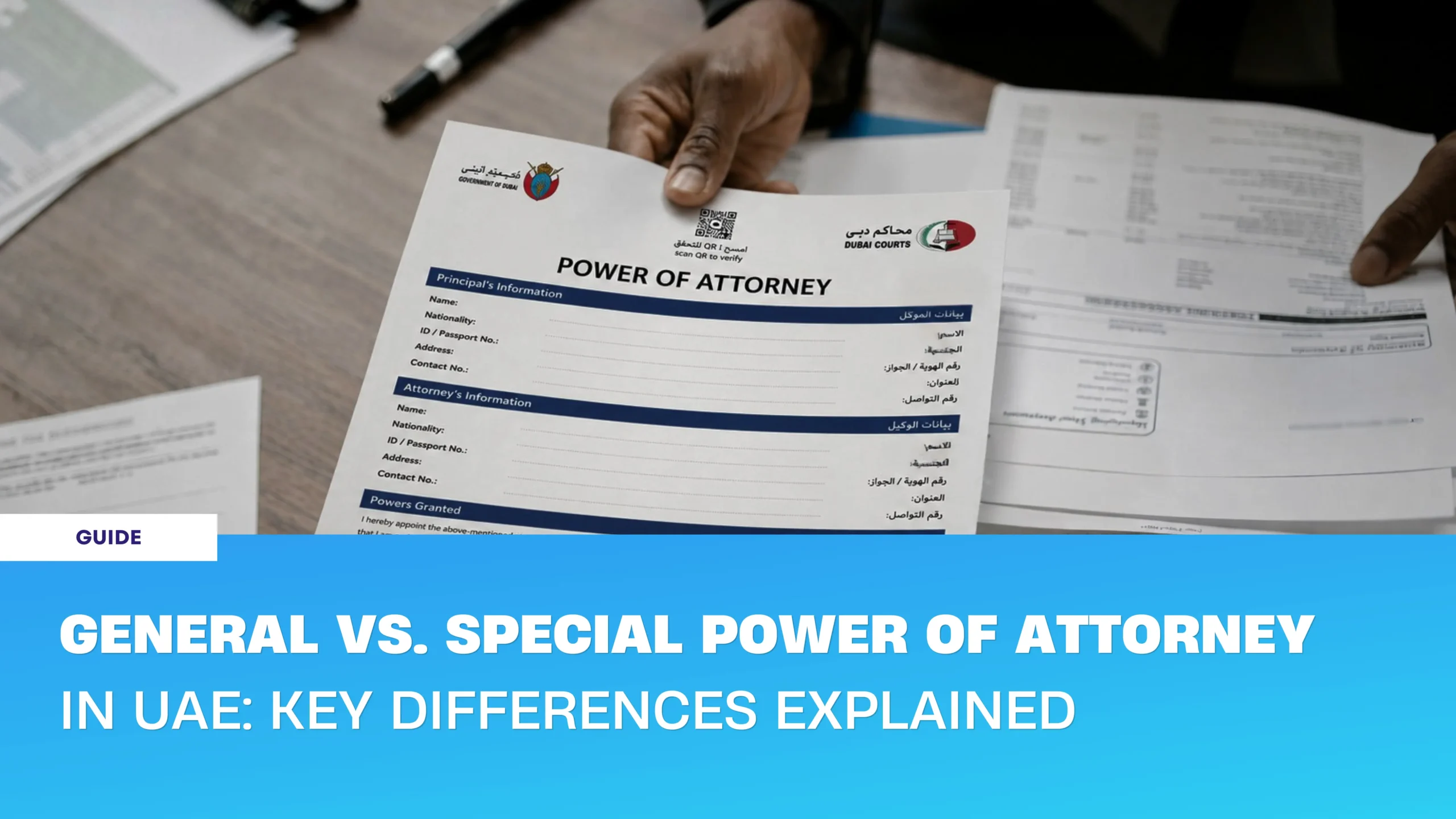
The general Power of Attorney will give the agent authority to do many kinds of things on behalf of the principal without any restrictions imposed on him. The general POA will remain in effect until the principal withdraws it or until its expiry date set by the Principal.
In contrast, the special Power of Attorney gives the agent authority only for carrying out one or a certain group of actions and expires once the action is performed or until its expiry date is set by the Principal.
Both documents have a similar legal basis, which includes Federal Law No. 5 of 1985, the UAE Civil Transactions Law. In addition, they should be legalized. It is necessary because each kind of transaction requires either one kind of power of attorney or another.
Key Takeaways
- A general POA gives broad, ongoing authority across multiple matters. A special POA limits the agent to a specific task.
- The validity of the power of attorney varies in both; a general POA shall stay valid until it is terminated either by expiry date or by law or by its revocation prior to its expiry date, whereas the special POA shall expire on the accomplishment of authorized activity or on expiry date.
- A general POA requires a higher level of trust between the principal and agent due to its broad scope. A special POA offers more control by naming exactly what the agent can and cannot do.
- The authorities of the UAE may need a Special POA to complete certain transactions. Transactions such as the sale or purchase of property or automobiles, court appearances, transfer of shares of companies, and others are usually required to have a Special POA that specifies the concerned subject matter.
- Choosing the correct POA type prevents delays and rejections: UAE government departments, courts, the Dubai Land Department, and the RTA often have specific requirements regarding the type of POA they accept. Selecting the right document ensures smoother processing and legal compliance.
Table of Contents
What Is a Power of Attorney?
A power of attorney (POA) is a notarized document that allows one person, known as the principal, to authorize another person, known as the agent, to act on their behalf in specific or broad matters.
Everything the agent does under the POA is considered done by the principal. In the United Arab Emirates, the power of attorney law is regulated by Federal Law No. 5 of 1985 concerning Civil Transactions, which specifies the procedures of creation, validity, and termination of a power of attorney.
A power of attorney is frequently used by expatriates who reside outside the UAE, in cases where they need help managing their properties, handling banking issues, running their businesses, completing car sales transactions, or attending legal proceedings on their behalf.
What Is a General Power of Attorney?
A general power of attorney grants the agent broad authority to act on behalf of the principal across a wide range of matters. There is no restriction on the type of actions the agent can carry out, which makes the general POA suitable for situations where ongoing, open-ended representation is needed.
The key responsibilities that are included under the general POA are:
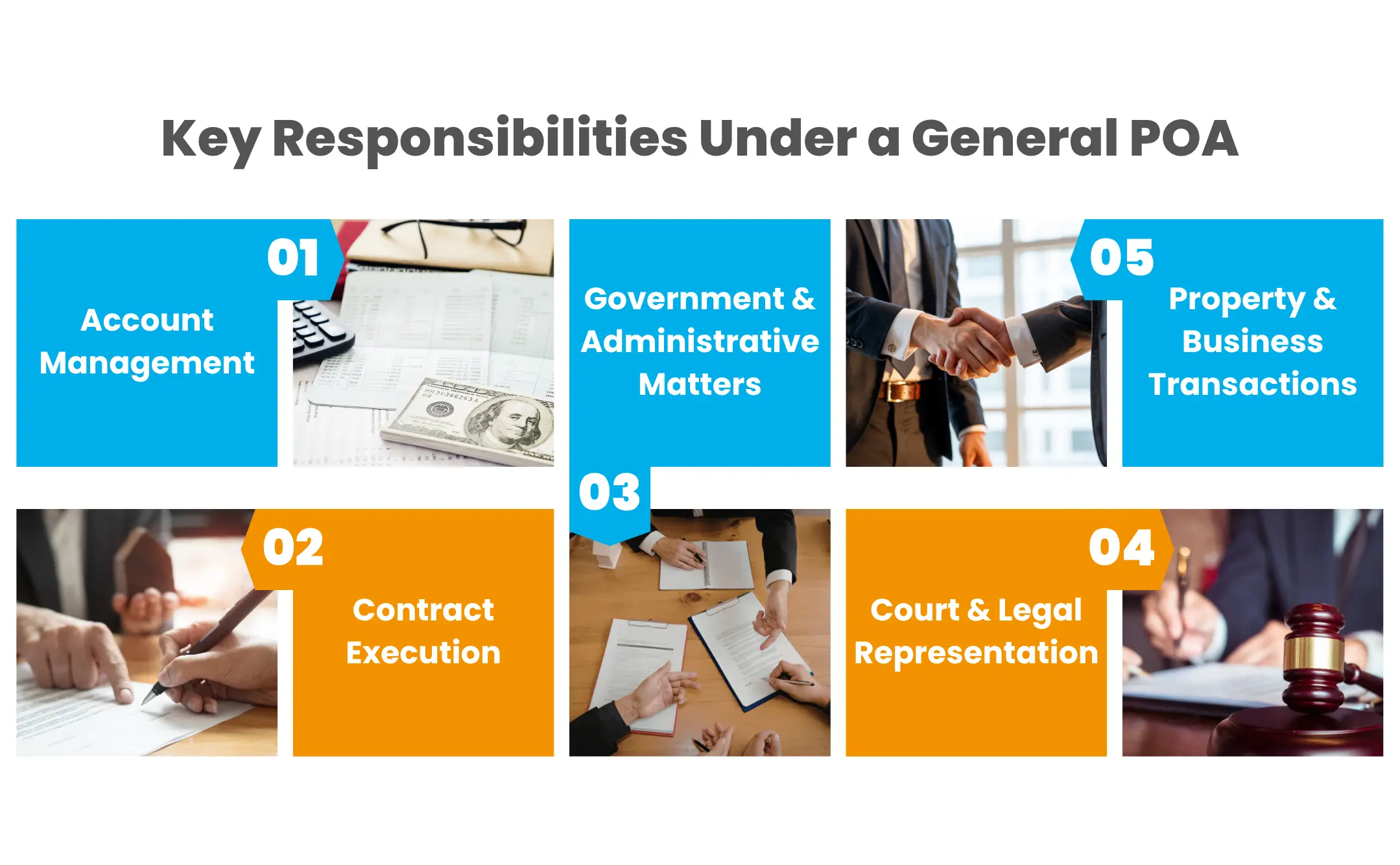
- Managing accounts, including making bank accounts, deposits, withdrawing money, and other financial transactions
- Executing any contract or agreement on behalf of the principal
- Administrative issues with any governmental body in all the Emirates
- Representation of the principal to any court or official organization
- Transactions involving the purchase, sale, and management of any properties or business concerns of the principal
For expatriates leaving the UAE but still keeping their financial or other resources, such as accounts, property, etc., in the UAE, it is convenient to use the general POA.
Owners of businesses who are travelling frequently will also find it useful when providing authority for another person to make any decision in their place and on their behalf.
The general POA is not terminated automatically once its purpose is fulfilled. It can only be terminated by the revocation by the principal, the death of either party, or when the principal becomes incapable. It can also be limited to a certain duration of time.
What Is a Special Power of Attorney?
A special power of attorney restricts the agent’s authority to one specific task or a defined set of actions. The POA document names exactly what the agent is authorized to do, and the agent cannot act beyond those stated powers.
Whatever act is performed beyond the terms set out in a special power of attorney is not considered valid under UAE law. Upon completion of the agreed-upon task, the special power of attorney becomes null and void without requiring further steps from the principal.
Common uses of a special POA in the UAE include:
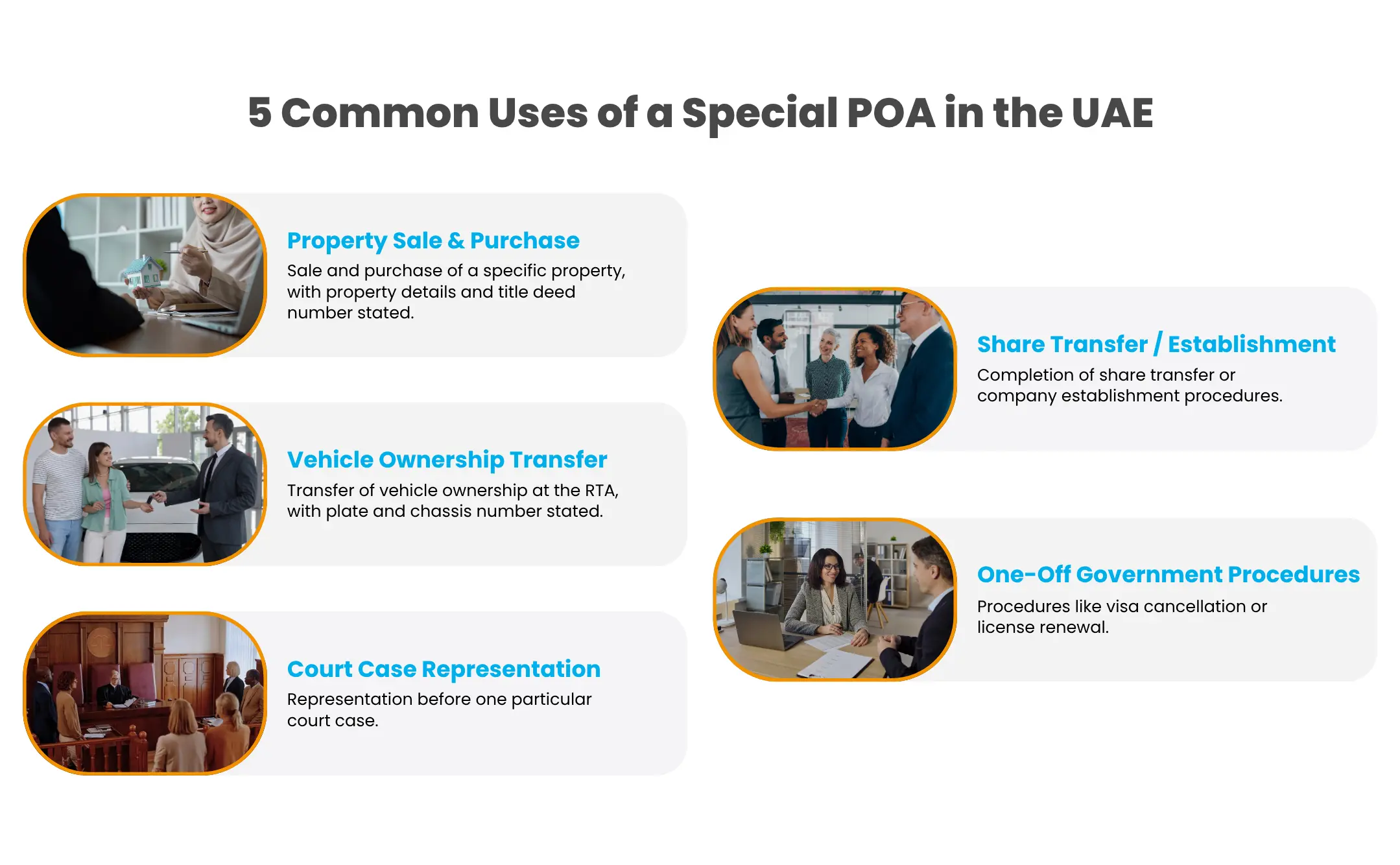
- Sale and purchase of a certain property, with the property details and title deed number being clearly stated in the document
- Transfer of vehicle ownership at the RTA, with plate and chassis number stated
- Representation before one particular court case
- Completion of the process of share transfer or establishment of a company
- One-off procedures like visa cancellation or license renewal in the government department
It is also the type most often requested by the UAE government departments. When selling properties using a power of attorney, the Dubai Land Department adopts a cautious approach and refuses a general power of attorney for property sales.
What it requires is a special power of attorney containing property details, title deed number, and authority to sell the said property. The same applies at the RTA for vehicle transfers and at free zone authorities for certain corporate actions.
For a step-by-step breakdown on choosing between the two types, read the full guide on how to decide whether a general or special power of attorney is the right fit.
Key Differences Between General and Special Power of Attorney
Factor |
General POA |
Special POA |
Scope of authority |
Broad, covers multiple matters | Limited to specific named task(s) |
Duration |
Valid until revoked or terminated by law | Expires when the task is completed |
Risk level |
Higher, due to open-ended powers | Lower, with clear boundaries |
Best suited for |
Ongoing management, expats abroad, business delegation | Single transactions like property sale, vehicle transfer, court case |
Accepted for property sale at DLD |
Often rejected | Required and accepted |
Revocation |
Must be formally revoked and notified | Automatic upon task completion |
Cost of misuse |
Potentially unlimited | Contained within the stated scope |
Not sure which POA type fits a specific situation? POA.ae‘s drafting team can help choose the right document, handle notarization, and manage attestation across all UAE emirates. Get started today.
When to Use a General POA vs. a Special POA in the UAE
Based on the nature of your transaction, you must apply the relevant POA type as per the instructions provided by the UAE authorities. Submitting irrelevant documentation will cause unnecessary rejections.
Transactions Involving Property
- If you want to sell your property in any emirate in the UAE, you need to have a special power of attorney, including all necessary information such as the title deed.
- General POA applies to property management activities, including rent payments, building maintenance, handling of tenant-related issues, etc.
Company and Business Management
- Full business management in the case of signing agreements and licenses, opening bank accounts, governmental affairs management, etc., can be effectively handled using a general POA.
- If your company or business requires you to do something like forming a company, purchasing stocks, etc., then a special POA would be preferred.
Vehicle Sale or Transfer
- The RTA might need a special POA that should contain details about the vehicle, including the plate number and chassis number, along with the permission to sell or transfer.
- General POA may not be sufficient for any dealings of vehicles at RTA.
Representation in Court
- In order to meet court approval, a POA that specifically mentions the case must be used.
- A POA is broader in scope and covers all cases; however, many courts prefer one that relates directly to the case at hand if available.
POA.ae prepares both general and special powers of attorney, handling the entire process from drafting and translation to notarization and attestation across all UAE emirates.
Frequently Asked Questions
1) What is the difference between a general and a special power of attorney in the UAE?
A general POA grants broad authority to act on behalf of the principal across multiple matters. A special POA limits the agent’s authority to one specific task or transaction.
2) Can a general power of attorney be used to sell property in Dubai?
In most cases, no. The Dubai Land Department requires a special POA that includes the property details, title deed number, and the specific authorization to sell. A general POA is likely to be rejected for property sale transactions.
3) How long is a power of attorney valid in the UAE?
A general POA remains valid until formally revoked or terminated by law (death, loss of capacity). A special POA expires once the specified task is completed. Either type can include a fixed validity period set by the principal.
4) Is a power of attorney valid after the principal passes away?
No. Under UAE law, all powers of attorney terminate automatically upon the death of the principal. Estate matters are handled through a Will or inheritance proceedings, not through a POA.
5) Can a special POA cover more than one task?
Yes, provided each task is explicitly stated in the POA wording. A special POA can authorize multiple defined actions, but it cannot grant open-ended authority. Each action must be clearly described.
6) What are the risks of granting a general power of attorney?
The primary risk is misuse. Because the agent has broad authority, they could make unauthorized transactions, sell assets, or incur liabilities in the principal’s name. Safeguards include choosing a trusted agent, setting an expiry date, and working with a POA specialist during drafting.
7) Which type of POA does the RTA accept for vehicle transfers?
The RTA usually requires a special POA that includes the vehicle details (plate number, chassis number) and the specific authorization for sale or transfer. A general POA might or might not be accepted depending on the situation.
Disclaimer: poa.ae is a registered trademark and an online portal. It is NOT a notary office or a law firm. Any reference to potential legal services or notary services is outsourced to lawyers, law firms, or notaries licensed to practice in an appropriate jurisdiction. Your access to the website and use of our services is subject to our Terms and Conditions, Cookie Policy, nd Privacy Policy.
About the author

Recent Posts



September 20, 2026

August 27, 2026

August 20, 2026